- Home
- >
- News
- >
- Product News
- >
- Why Your Cone Crusher's Capacity Is Not the Same as Your Qualified Output
Why Your Cone Crusher's Capacity Is Not the Same as Your Qualified Output
Let us imagine the fine crushing case that frequently occurs: a discharge setting at 9 mm, target products size is ≤12 mm. At best, around 72% of the crushed materials will actually conform to the target particle size. The remaining portion has to circle back into the crushing circuit. Here, the circulating load might well be a high 178% - which means that you are feeding back 1.8 times as much as a qualified product. Naturally, the consequences are what rock quarry workers see: you're getting many needle-like grains, a lot of flat ones too which is really a bad combination, your energy bill goes up with each of these, a very high ton per qualified unit, and a constant struggle in running the screening circuit.
The problem is not just the crusher. Rated capacity basically means how much your machine can deliver at the highest level under the best conditions. However, what you actually get depends on a wide array of feed-related characteristics as well as machine parameters like feed size distribution, moisture, density, work index, screen aperture size, screening efficiency, chamber type and recirculation.
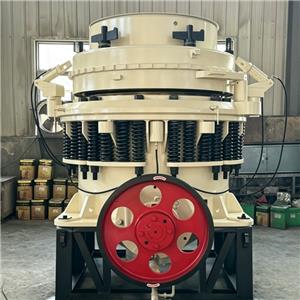
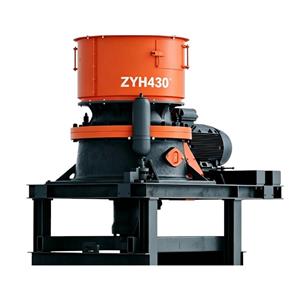
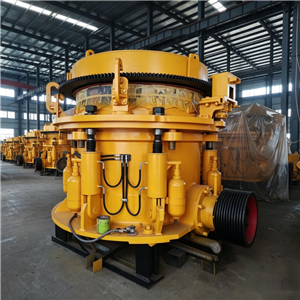
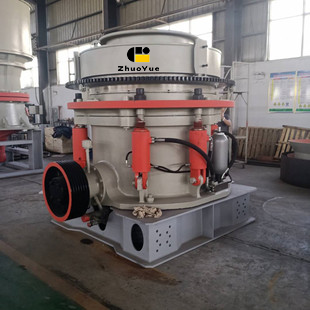
A crusher that seems to be a good fit on paper might deliver far less than the nominal rate in a real operating circuit if the above parameters aren't right. For this duty, the ZHP300 multi-cylinder hydraulic cone crusher is a practical starting point: fine cavity, 8–12 mm discharge setting, 250 kW motor, nominal capacity 90–450 t/h. The hydraulic system handles discharge adjustment, overload protection, and setting recovery. The PLC system monitors eccentric-sleeve speed, crushing pressure, oil temperature, oil pressure, motor load, and CSS position.
How to close the gap. Closed-circuit screening is the effective way to keep circulating load within target. With the right screen aperture and CSS combination, the aim is to raise the qualified share from around 72% to 85–90%, bring circulating load down from 178% to 100–120%, and cut specific energy per qualified ton by up to 10–20%. Actual results depend on feed conditions, circuit design, and operating discipline.
Carry out a steady-state test for at least 8 hours with sampling every 30 minutes. Qualified output: mass of the specified-size product / steady-state operating time. Circulating load: (% material returned) / (% new feed) × 100. Specific energy: total crusher, screen, and circulating conveyor energy / mass of qualified product. Any agreed performance metrics should be written into the contract。
If you are planning a fine-crushing circuit, send us the material type, feed gradation, target product size, and target capacity. We will recommend the model, cavity, and CSS setting—and tell you what qualified output to expect, not just the nominal rating.